SPONSORED BY NIWAA dermatologist reviews it
Beef fat on your face. I get asked about this every week.
A board-certified dermatologist on what tallow actually is, what it can do for a dry skin barrier, and the large group of people who should not go near it.

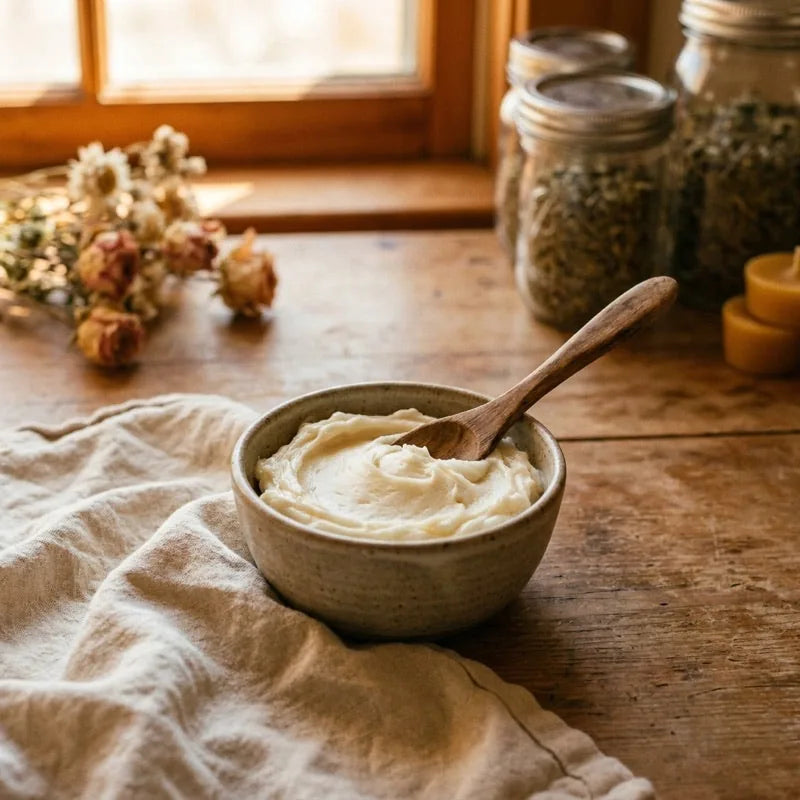
Patients ask me about beef tallow roughly once a week now, and almost all of them apologise before they ask.
My relative asked me to look at a jar of balm her family sells and to say publicly what I thought of it. I agreed on one condition: that I could also write down what it does not do.
Let me start with the reaction most people have, because it is a reasonable one. Rendered beef fat, on your face, in 2026. It sounds like a step backwards.
The chemistry is not the objectionable part
Beef tallow is composed of roughly forty percent oleic acid, twenty-eight percent palmitic acid and twenty percent stearic acid. Human sebum, the oil your own skin produces, is dominated by the same three fatty acids in broadly similar proportions.
When you apply tallow you are not introducing a foreign material. You are applying something that closely resembles what your skin already makes.
What dry skin actually is
It helps to be specific about the problem.
The outermost layer of your skin is often described as brick and mortar: cells held together by a lipid matrix made of ceramides, cholesterol and free fatty acids. That matrix is what stops water escaping. When it is depleted, water leaves faster than it should. We call this transepidermal water loss, and it is the mechanism behind almost everything people describe as dry skin: the tightness, the flaking, the way it worsens in winter when the air is drier and indoor heating is running.
So the useful question about any moisturiser is not how hydrating it feels in the first minute. It is whether it reduces water loss, and for how long.
Why the product you are using stops working by lunchtime
Most lotions are predominantly water. To keep water and oil combined in a single stable bottle you need emulsifiers, and emulsifiers are surfactant-type molecules, chemically related to what is in your cleanser.
This creates a tension that is rarely explained to patients. The water phase evaporates within a short time of application, and evaporation can carry away some skin moisture with it. Meanwhile the emulsifier system, applied repeatedly over months, is not doing your barrier lipids any favours.
This is not a scandal and it does not mean lotions are useless. It does explain the extremely common complaint that a moisturiser works for an hour and then the tightness returns.
An anhydrous product, one containing no water at all, sidesteps that entirely. There is no water phase to evaporate and no emulsifier required, because there is nothing to emulsify.
Five ingredients, no water, no emulsifier
That is the whole argument for this category, and it is a narrow one. It is also, for a lot of people, the missing piece.
See the ingredientsFree shipping · 90-day money-back promise
The honey is the part I found interesting
Most tallow balms on the market list honey and never explain it, which I find strange, because it is the more elegant half of the formula.
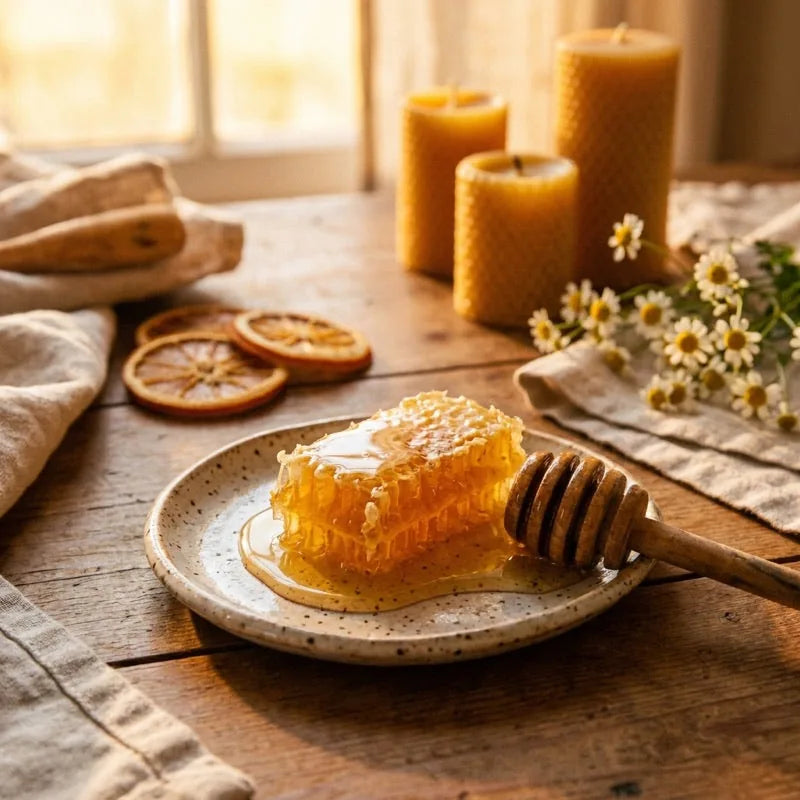
An occlusive slows water leaving. A humectant attracts and binds water. Tallow is the first. Honey is the second.
On its own, an occlusive seals in whatever is already present, which on genuinely depleted skin may not be much. Pairing a humectant with an occlusive, draw water in and then hold it there, is a standard and sound approach in dermatology. It is what this formula is doing, whether or not the person who inherited the recipe would have described it in those terms.
Who should not use this
Humectant under occlusive
Honey draws water in. Tallow holds it there. Two ingredients doing two different jobs, which is more than most of this category manages.
See the balm · $29.90Free shipping · 90-day money-back promise
What this product is not
It is not a treatment. It does not treat eczema, atopic dermatitis, psoriasis or any other skin condition, and nobody should use it in place of care their doctor has prescribed. If you have an inflamed, weeping or infected flare, that is a medical problem and it needs a medical answer, not a balm.
What a well-made occlusive can do is support the barrier on dry, intact skin and reduce how fast water leaves it. That is a modest claim. It is also, for a great many people with chronically dry hands or dry, tight, reactive skin, the thing that was actually missing.
I will also say plainly that there are no substantial clinical trials on tallow in skincare. What exists is compositional data and a long history of use. If you require trial evidence before you put something on your skin, that is a defensible position and you should wait.
Why I was willing to put my name on this one
For dry, intact, reactive skin
Not a treatment. A barrier support step, with a short enough ingredient list that you can check every line of it.
Read the ingredientsPatch test first. Inner elbow, two days.
Not sure it suits your skin? Take the 60-second quizI can account for every ingredient
The list is five items long. In a category where a typical label runs past thirty ingredients, most of them present to stabilise the water, that is not nothing. It matters particularly for patients who have found they react to preservative or emulsifier systems in mainstream products.
No water means no preservative system
Anhydrous products do not need the preservatives that water-containing emulsions require, because there is no water phase for microbes to grow in. For reactive skin that is a meaningful simplification.
They were willing to publish the paragraph telling you not to buy it
I have reviewed products for people before. The section above, the one naming who should avoid this, is not a section brands usually agree to run. That was the point at which I decided to put my name to it.
— Dr. Alan Whitfield, MD
Board-certified in dermatology.
He reviewed the product and was not paid for a positive opinion.
It is as simple as 1, 2, 3
- Order todayPick your scent, or the unscented one if you react to things. Free shipping on every order.
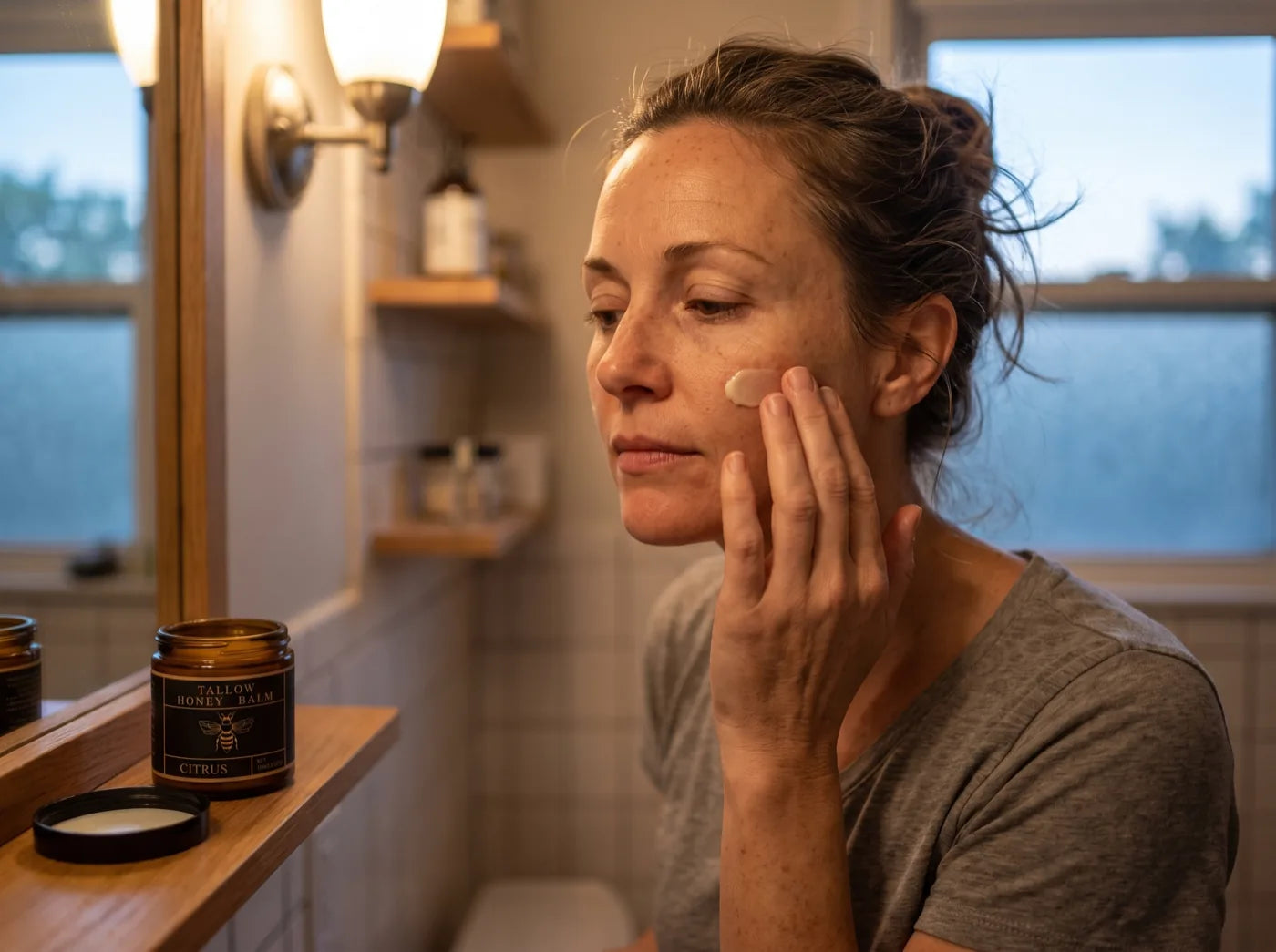
- It arrives in 3 to 5 daysA pea-sized amount on damp skin, once a day. That is the whole routine.
- Judge it after four nightsIf your skin is not calmer in 90 days, we refund you and you keep the jar.
Reviewed, with reservations stated
Tallow Honey Balm
For dry, cracked, reactive skin. Not for oily or acne-prone skin.
- Five ingredients, no water, no emulsifier
- No preservative system required
- Unscented option for reactive skin
- Free shipping on every order
- 90 days to send it back, keep the jar
Poured by hand in small batches
See the balm · $29.90Not a treatment for any skin condition. Patch test first.
Not sure it suits your skin? Take the 60-second quiz